Monday, 5 November 2012
REFLECTION on BRAKES
Brakes, the most important part for vehicle safety. All cars have different ways how the brakes work. I will explain to you what i have learned.
Moving energy is made into heat energy as the break lining material rubs against the rotating metal drum or disc rotor.
Brake pads play a imported role, your break pads should always have more then 1.5mm of material. (Asbestos was the most common one being used, but it is highly poisonous)
When we took the brake pad out, we had to check for uneven ware and marks on it, one of the brake pads was worn unevenly, but we didn't know why, until we learned about brake callipers.
Brake callipers consist of many parts, but most importantly it holds your brake pads into place which helps apply the break, depending on the brake system the callipers hold pistons which pushes the brakes onto the rotor.
There are fixed and sliding callipers. Fixed callipers can have up to 2 to 4 pistons, 2 piston callipers have one piston on each side of the disc, each piston has its own disc pads.When the brakes are applied the hydraulic pressure forces both piston inwards causing the pads to come in contact with the rotating disc.
Brake disc or rotor:
After a excessive use of your rotor, you can start getting heat spots and cracks which is what i suffered. when your rotors gets marks and things on it then it needs to be machined so its got no run out or warpage but it cant go under your manufactures specification.
Flaring brake pipes is something else we managed to do, this was to give us a idea of how to double and single flare and how it works. We used the flaring tools that was provided by Unitec, it was a bit hard at first but once the technique is right it works almost perfect
Brake safety, ABS.
ABS isn't as complicated as it may seems, it is an vehicles system that allows the wheels on a vehicle to maintain contact with the road surface according to driver inputs while braking preventing the wheels from locking up (ceasing rotation) and avoiding uncontrolled skidding.
Brake Roller testing was done at Mt Albert campus

Sunday, 4 November 2012
More on WOF
 This is what your WOF slip looks like
Legally, you must have your vehicle inspected for warrant of fitness every 12 months if your vehicle is less than six years old, every 12 months if your vehicle is more then six years old.
Modifying your vehicle
You can modify, customise or retune your car, motorcycle, van or ute. But any changes you make must not put you or others at increased risk when you're on the road. That's why any modifications you do make may need a low volume vehicle (LVV) certification to get a warrant of fitness (WoF).

Modified suspensions, which could alter vehicle handling. An LVV certifier must check any modifications exceeding the specified threshold.
Engine conversions or modifications. An LVV certifier will need to check any potential effects of engine modifications on the adequacy of your vehicle's braking system.
Racing seats, which can provide you with better support but, if incorrectly attached and positioned in the vehicle, can reduce the effectiveness of your safety belts.
Steering modifications are particularly high risk and should be done only by experts.
Warrant of Fitness (WOF)
A warrant of fitness (WoF) is a regular check that your vehicle meets required safety standards, at the time of inspection. It’s your job to keep your vehicle in warrantable condition at all times. For example, while tyres on your vehicle may pass on the day of your warrant inspection, you’ll need to replace them as soon as the tread gets to the minimum depth. If you wait until the next inspection before replacing them, you increase your risk of having a crash or receiving a fine.
Common seatbelt problems
Fraying and cuts to the belt material also called the 'webbing'. Even a small tear can decrease strength by up to 60 percent. In a crash the belt could snap and kill you
Damaged buckle
Seat belt not retracting
Fading on the belt
Warrant of fitness covers
1.Tyre condition which includes tread depth
2. Brake operation
3. Structural condition, rust is not allowed in certain areas
4. Lights
5. Glazing (is your windscreen safe?)
6. Windscreen washers and wipers
7. Doors
8. Seat belts
9. Air bags (if fitted)
10. Speedometer must be working
11. Steering and suspension (must be safe and secure)
12. Exhaust, there must be no leaks and the exhaust must not smoke or be louder
than the original exhaust system
13. Fuel system, must have no leak
Suspension and Steering (part 2)
Wheel Alignment
Wheel alignment should be checked whenever new tires are installed, suspension components installed, when the vehicle has encountered a major road hazard or curb and any time unusual tire wear patterns appear.
Wheel Alignment is the Measurement of complex suspension angles and the adjustment of a variety of suspension components. It is a suspension tuning tool which greatly influences the vehicle's handling and tire wear.
Wheel alignment consists of adjusting the angles of the wheels so that they are parallel to each other and perpendicular to the ground, thus maximizing tire life and ensures straight and true tracking along a straight and level road.
The primary static suspension angles that need to be measured and adjusted are caster, camber, toe and thrust angle.
Camber is the angle of the wheel, measured in degrees, if the top of the wheel is tilted out then the camber is positive, if it's tilted in, then the camber is negative.
Caster is the angle of the steering pivot, measured in degrees.
Toe in and out


Steering Axis Inclination (SAI) is the measurement in degrees of the steering pivot line when viewed from the front of the vehicle. On a SHORT-LONG ARM (SLA) SUSPENSION the line runs through the upper and lower ball joints.
Thrust angle is the direction that the rear wheels are pointing in relation to the center line of the vehicle.
Steering box

Shock Absorbers
In a vehicle, shock absorbers reduce the effect of travelling over rough ground, leading to improved ride quality and increase in comfort. While shock absorbers serve the purpose of limiting excessive suspension movement, their intended sole purpose is to dampen spring oscillations. Shock absorbers use oil and gasses to absorb excess energy from the springs. Spring rates are chosen by the manufacturer based on the weight of the vehicle, loaded and unloaded.
Steering Safety
For safety reasons all modern cars feature a collapsible steering column (energy absorbing steering column) which will collapse in the event of a heavy frontal impact to avoid excessive injuries to the driver. Air bags are also generally fitted as standard. Non-collapsible steering columns fitted to older vehicles
Wheel Bearing

Suspension and steering (part 1)
BODY (chassis types)
1.Monocoque
2. Backbone Chassis
3. Body on frame
4. Sub Frame
SUSPENSION PRINCIPLES

Tapered Leaf Spring: the tapered leaf springs are the modified forms of the conventional leaf springs. Light Weight- Nearly 60% of the corresponding conventional spring. There is no inter-leaf friction in case of single taper leaf spring. Even in case of heavy vehicles where more leaves may be required, the number of such leaves is still less than in case of conventional springs.
The stresses are lower and more uniform compared to the conventional springs, thus giving longer life.
They occupy less space.
In case of single taper leaf spring, there is no collection of moisture between the leaves and hence no fatigue due to corrosion damage at the asperities of contact surfaces.

Coil spring: The coil springs are the most commonly used springs in light duty vehicles. They are mainly used with the independent suspension, though they have also been used in the conventional rigid axle suspension as they can be well accommodated in restricted spaces. The energy per unit volume is almost double in the case of coil springs than the leaf springs. The coil spring is a length of round spring steel rod that is wound into a coil. Unlike leaf springs, conventional coil springs do not develop inter-leaf friction. Therefore, they provide a smoother ride.

Torsion Bar: Torsion bar is simply rod acting in torsion that takes shear stresses only. These are made of heat treated alloy spring steel. Torsion bar is fixed at one end to the frame of the vehicle. At one end, the torsion bar is fixed firmly in place to the chassis or frame of a vehicle where as other end is attached to the axle, suspension arm. The force produce due to the vehicle create the torque on the bar.


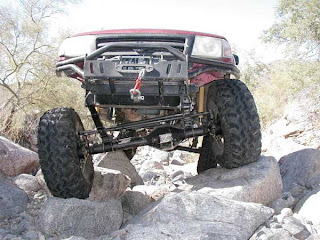


1.Monocoque
2. Backbone Chassis
3. Body on frame
4. Sub Frame
SUSPENSION PRINCIPLES
- To restrict road vibrations from being transmitted to the various components of the vehicle
- To protect the passengers from road shocks
- To maintain the stability of the vehicle in pitching and rolling
SPRING TYPES
Leaf spring: Leaf springs are one of the oldest forms of damping materials ever made. They are very simple in design with a non-complicated construction. They can be a mono-leaf or a multi-leaf type. Use of longer springs gives a soft suspension. Generally, rear springs are kept longer than the front springs. This causes them to vibrate at different frequencies, which prevents excessive bounce. The springs are provided with metallic or fabric covers to exclude dirt.

The stresses are lower and more uniform compared to the conventional springs, thus giving longer life.
They occupy less space.
In case of single taper leaf spring, there is no collection of moisture between the leaves and hence no fatigue due to corrosion damage at the asperities of contact surfaces.
Coil spring: The coil springs are the most commonly used springs in light duty vehicles. They are mainly used with the independent suspension, though they have also been used in the conventional rigid axle suspension as they can be well accommodated in restricted spaces. The energy per unit volume is almost double in the case of coil springs than the leaf springs. The coil spring is a length of round spring steel rod that is wound into a coil. Unlike leaf springs, conventional coil springs do not develop inter-leaf friction. Therefore, they provide a smoother ride.
Torsion Bar: Torsion bar is simply rod acting in torsion that takes shear stresses only. These are made of heat treated alloy spring steel. Torsion bar is fixed at one end to the frame of the vehicle. At one end, the torsion bar is fixed firmly in place to the chassis or frame of a vehicle where as other end is attached to the axle, suspension arm. The force produce due to the vehicle create the torque on the bar.
There are also two main disadvantages of torsion bar suspensions. The first is that it does not take the braking or driving thrust so that additional linkages have to be provided for that purpose. The second disadvantage is the absence of friction force, and hence of damping which is a necessity to control the vibrations produced due to road shocks.
Hydraulic Spring (Shock Absorber): In hydraulic shock absorber fluid in a cylinder is forced by piston and thus resistance to the piston movement is developed that provides damping effect.

SUSPENSION TYPES
Solid Axle: The solid, or beam, axle is used in the rear suspension of many front-engined, rear-wheel drive cars, and light commercial vehicles, and as the front suspension on many heavy commercial vehicles.

Dead Axle: A dead axle only supports the vehicle and doesn't transmit any drive. With a live axle, the drive is transmitted through the final drive unit and axles to the wheels.

Independent Suspension: Independent suspension helps keep unsprung mass low. Also, if a wheel hits an irregularity, it won't upset the opposite wheel on the same axle. It allows wheel camber to be adjusted, or designed into the suspension geometry.

Rear independent suspension: For independent suspension on the rear of a vehicle, many front-wheel drive cars use a McPherson strut at the rear. On rear-wheel drive vehicles, the suspension has to allow for the external drive shafts.

Rear wheel drive independent suspension: On rear-wheel drive vehicles with independent suspension, the final drive unit is fixed to the vehicle frame. Drive is transmitted to each wheel by external drive shafts.
SWAY BAR
A sway bar or anti-roll bar or stabilizer bar is a part of an car suspension that helps reduce the body roll of a vehicle during fast cornering or over road irregularities. It connects opposite (left/right) wheels together through short lever arms linked by a torsion spring. A sway bar increases the suspension's roll stiffness, its resistance to roll in turns, independent of its spring rate in the vertical direction.Sunday, 14 October 2012
Steering Rack and Power steering pump!


Rack and pinion steering is quickly becoming the most common type of
steering on cars, small trucks and SUVs. It is actually a pretty simple
mechanism. A rack and pinion gear set is enclosed in a metal tube, with each
end of the rack protruding from the tube. A rod, called a tie rod, connects to each end of the rack.
The pinion gear is attached to the steering shaft.
When you turn the steering wheel, the gear spins, moving the rack. The tie rod
at each end of the rack connects to the steering arm on the spindle

The rack-and-pinion gear set does two things:
- It converts the rotational motion of the steering wheel into the linear motion needed to turn the wheels.
- It provides a gear reduction, making it easier to turn the wheels.
On most cars, it takes three to four complete revolutions of the steering wheel to make the wheels turn from lock to lock from far left to far right.
Part of the rack contains a cylinder with a piston in the middle. The piston is connected to the rack. There are two fluid ports, one on either side of the piston. Supplying higher-pressure fluid to one side of the piston forces the piston to move, which in turn moves the rack, providing the power assist.
POWER STEERING PUMP
Describe a Trunion and where it is found?
In older cars, the trunnion
is part of the suspension and either allows free movement of the rear wheel hub
in relation to the chassis or
allows the front wheel hub to rotate with the steering. On many cars the
trunnion is machined from a brass or bronze casting and is prone to failure if
not greased properly, American motors used moulded rubber "Cleve bloc"
bushings on the upper trunnion to seal out dirt and retain silicone lubricant
for the life of the car
ABS
Anti lock braking system (ABS) is an vehicles system that allows the wheels on a vehicle to maintain contact with the road surface
according to driver inputs while braking preventing the wheels from locking up (ceasing rotation) and
avoiding uncontrolled skidding.
Typically ABS includes a central electronic control unit (ECU), four wheel speed sensors and at least two
hydraulic valves within the brake hydraulics. The ECU constantly monitors the rotational speed of each wheel, if it
detects a wheel rotating significantly slower than the others, the wheel speed
sensor sends a signal to the ECU. It
actuates the valves to reduce hydraulic pressure to the brake at the affected
wheel, therefore reducing the braking force on that wheel, the wheel then turns
faster. Conversely, if the ECU detects a wheel turning significantly faster
than the others, brake hydraulic pressure to the wheel is increased so the
braking force is reapplied, slowing down the wheel.
Main Components
Speed sensors
The anti-lock braking system needs some way of knowing when a wheel is
about to lock up. The speed sensors, which are located at each wheel, or in
some cases in the differential, provide this information.

Valves
There is a valve in the brake line of each brake controlled by the ABS. On
some systems, the valve has three positions, In position one, the valve is
open; pressure from the master cylinder is passed right through to the brake.
In position two, the valve blocks the line, isolating that brake from the
master cylinder. This prevents the pressure from rising further should the
driver push the brake pedal harder. In position three, the valve releases some
of the pressure from the brake.

Pump
Since the valve is able to release pressure from the brakes, there has
to be some way to put that pressure back. That is what the pump does; when a
valve reduces the pressure in a line, the pump is there to get the pressure
back up.

Controller
The controller is an ECU type unit in the car which receives
information from each individual wheel speed sensor, in turn if a wheel loses
traction the signal is sent to the controller, the controller will then limit
the brake force (EBD) and activate the ABS modulator which actuates the braking
valves on and off.

Subscribe to:
Posts (Atom)